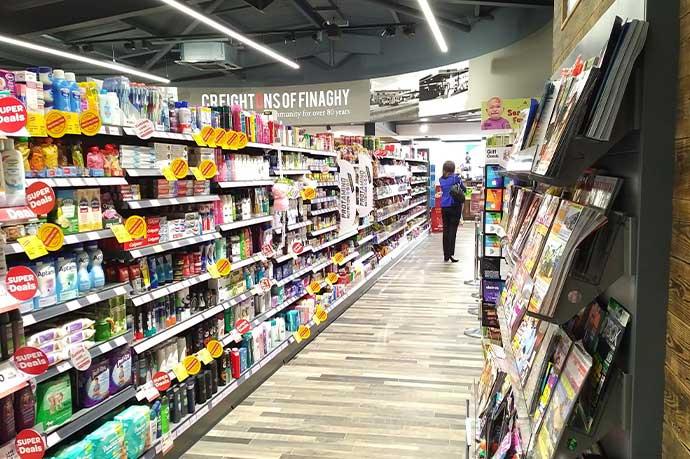
In 25 years of visiting stores and reading fixture tenders, I’ve learned one uncomfortable truth: most people sign off shelving they don’t really understand.
Clients rarely ask for load data. Side stability is often ignored. Critical details like steel quality, fixings, and how fitters behave on site are left to chance. Yet shelves are loaded, leaned on, climbed on and driven into every single day.
This is my attempt to give you a practical, no‑nonsense guide to what really matters technically, and how CAEM approaches it.
1. Load ratings: more than “how much can a shelf take?”
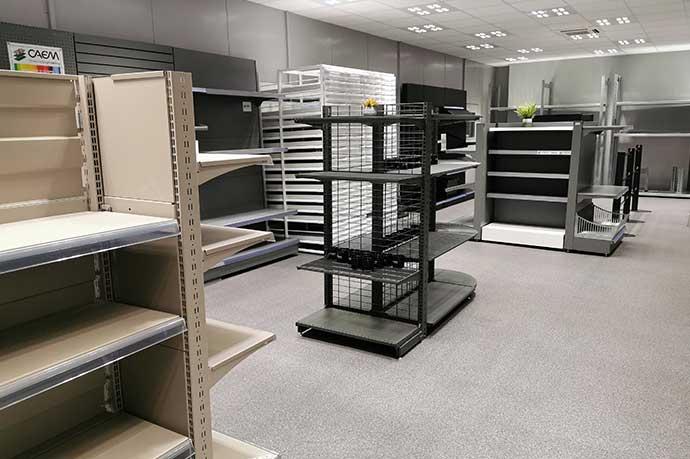
When we talk about “weight loading”, people often imagine a single number: “this shelf holds X kg”. In reality, safe load is the result of a whole system working together:
- The steel: grade, thickness, and consistency.
- The components: shelves, brackets, uprights, bases, backs, beams.
- The geometry: heights, bay widths, shelf depths, upright spacing.
- The precision of manufacturing: tolerances, welds, punches, and how well parts fit.
- The fixing method: to the floor, to the wall, or freestanding.
All of these interact. You can’t separate them.
This is why we actively invite clients to think about load, rather than quietly hoping no one asks. We want you to understand that:
- A shelf’s capacity is not just “metal thickness”; it’s the whole structure.
- Increasing shelf depth or bay width without re‑checking the system can destroy your safety margin.
- What looks “similar” between two suppliers on a drawing can behave very differently under real loads.
Internally, we train everyone – not just engineers – in the logic of weight loading:
- We use detailed videos explaining steel properties, upright and base behaviour, cantilever loads, and where limits arise.
- We teach how to read load charts, but more importantly, how to understand them – what assumptions they rely on, and when they no longer apply.
That shared understanding is what keeps us honest when we design, quote and say “yes” or “no”.
2. Stability: the silent safety issue
If load is about “how much weight”, stability is about “what happens when reality hits”:
- A customer leans on the top shelf.
- A cage nudges a bay from the side.
- Staff stack product higher than planned.
- A child climbs where they shouldn’t.
Side stability is one of the most underestimated aspects of shelving. Many specifications barely mention it, or assume that because it stands upright when empty, it will be safe when loaded and pushed.
Our view is simple:
- Base, upright, back and bracing all matter to stability.
- Connection between bays (how they link) matters.
- Floor fixing or wall fixing, where needed, is non‑negotiable.
We’ve even seen collapses on shelving from otherwise respectable providers. In my opinion, this often comes down to a culture of always saying “yes” – stretching designs to hit a price or a visual idea without stopping to check the real safety implications.
At CAEM, we will only say yes to a request if we can tune a safe design. If that means challenging heights, depths, or what you want to sit on the top shelf, we will do that. It’s not about being difficult; it’s about making sure no one gets hurt.
3. Fitters, “freedom” on site and hidden risks
Even the best design can be made unsafe by what happens on site.
With modular systems, there is a temptation for fitters – especially those not deployed by the manufacturer – to improvise:
- “Let’s just move this upright to here, it’ll be fine.”
- “We’ll remove this brace so the client can have an opening there.”
- “We’ll add an extra shelf, no one will notice.”
Clients sometimes ask for adjustments on the spot, and a fitter who doesn’t fully understand the system will say yes to keep everyone happy.
This is dangerous.
We’ve seen a case where:
- A client altered the kit system we had provided.
- A fitter proceeded to assemble a configuration that was technically unsafe.
- The problem was repeated across several sites over a number of years.
Eventually, the client asked us to audit and correct what was wrong. We went through locations, identified unsafe configurations and brought them back into line with a safe specification.
To avoid this, our own fitters are trained to stick to our specs:
- If they are asked to do something different on site, they are trained not to improvise.
- They will always check with head office before deviating from the engineered solution.
That discipline is the difference between “modular” and “make it up as you go along”.
4. What every retailer and architect should check
From my experience, there are a few non‑negotiable technical points I wish everyone would look at before approving a fixture spec:
Proven load ratings
- Per shelf and per bay, with clear assumptions (upright spacing, shelf position, fixing method).
- Backed by design, testing and a reputable manufacturer.
Steel quality and thickness
- Not just the nominal gauge, but consistency and sourcing.
- Cheap, inconsistent steel can behave unpredictably under load.
Stability design
- How side hits and forward tipping are managed.
- Whether the design is meant to be freestanding, wall‑fixed, or floor‑fixed – and how.
Coating and finishes
- Powder coating spec for corrosion resistance and durability, especially in demanding environments (near entrances, cold rooms, damp areas).
- Whether the system has a proven track record in similar environments.
System compatibility and origin
- Are components part of a coherent system from one engineering source, or a mix of unrelated parts?
- Does the supplier actually manufacture and control quality, or just assemble from many anonymous vendors?
These questions are not complicated, but they go a long way towards weeding out weak solutions.
5. CAEM’s approach: safety as a mantra, not a checkbox
Because I work across design, manufacturing, finance and site reality, safety is not something I leave to a department. It is a mantra we apply everywhere.
When visiting stores, we don’t just talk about the topic on the meeting agenda. We walk the store and look at the status of fixtures:
- Are there obvious stresses, deformations or unsafe improvisations?
- Are there bays that have been modified after installation?
- Is anything clearly overloaded or unstable?
Internally, we invest in training everyone:
- Not just to memorise a few numbers, but to understand the logic of weight loading and stability.
- From the properties of steel, to how base and upright and cantilever loads really function, to where limits arise.
- To read load charts and also to know when they no longer apply because something has changed.
In design and commercial discussions, we give ourselves permission to say no:
- No to unsafe requests.
- No to configurations that look attractive on paper but fail in reality.
- No to changes on site that bypass engineering judgement.
I won’t claim that this removes all risk. But it does mean that when you work with CAEM, you are working with a team that understands shelving as a piece of engineering, not just as “metal that holds product”.
6. How to use this as a retailer or specifier
If you take one thing from this, let it be this: don’t treat shelving as a commodity line on a spreadsheet.
Instead, when you next evaluate or design fixtures:
- Ask for clear load and stability information and make sure someone who understands it reviews it.
- Challenge any on‑site improvisation that isn’t checked with the manufacturer.
- Choose suppliers who manufacture, test and train – not just resell and say yes.
And if you’re unsure about whether a proposed fixture set‑up is really safe for how your stores operate, ask. The right manufacturer should be willing – and able – to explain it in terms you can understand, and to stand behind their answer.
Read the "SHELVING SAFETY WHITEPAPER"