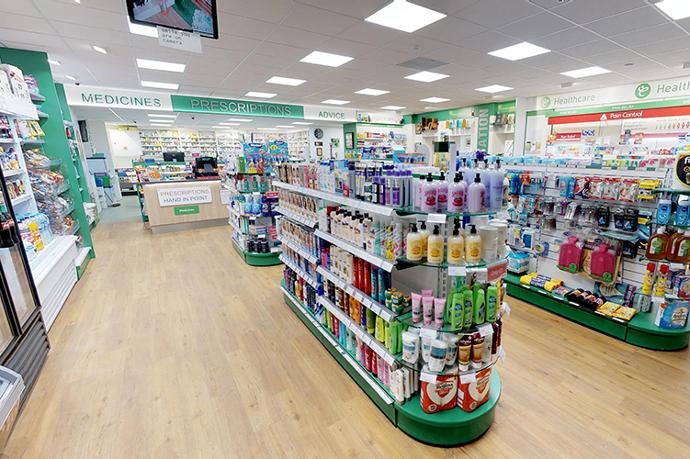
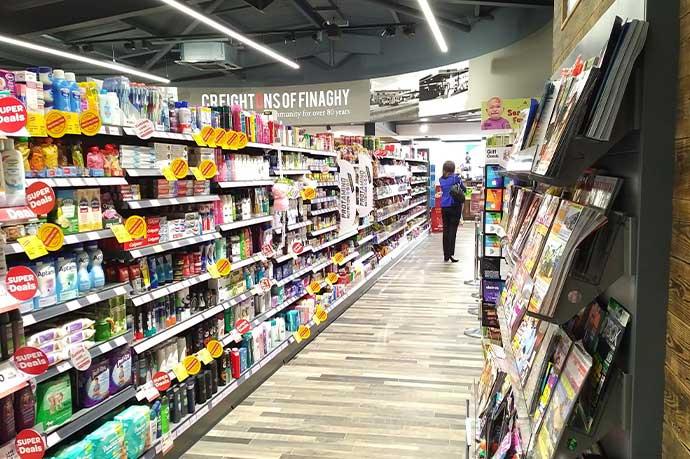
In UK retail, the “perfect” site rarely exists. You get narrow frontages, awkward columns, rising rents and more categories and services than the box was ever designed to hold. Convenience, C‑stores, pharmacies and small discount formats all live with the same pressure: do more, in less.
Fixtures can’t magic up extra square metres. But the right systems, layouts and details can make a small store behave like a much bigger one – without turning it into a cramped, unpleasant space.
The reality of small-box space problems
In compact formats, the same issues show up again and again:
- Aisles that are uncomfortably narrow, or feel even tighter because fixtures are too deep.
- Too many categories squeezed into a plan that was never updated when the offer changed.
- Back-of-house that’s far too small, forcing stock onto the shopfloor.
- Counters and back walls that are beautiful but rigid – they can’t adapt when ranges or regulations change.
The temptation is to keep adding “just one more” bay here or a deeper shelf there. Over time, that chips away at the shopping experience, staff circulation, cleaning and safety.
The real answer is to start from fixtures and layout as one system.
Why M25 wins in C‑stores
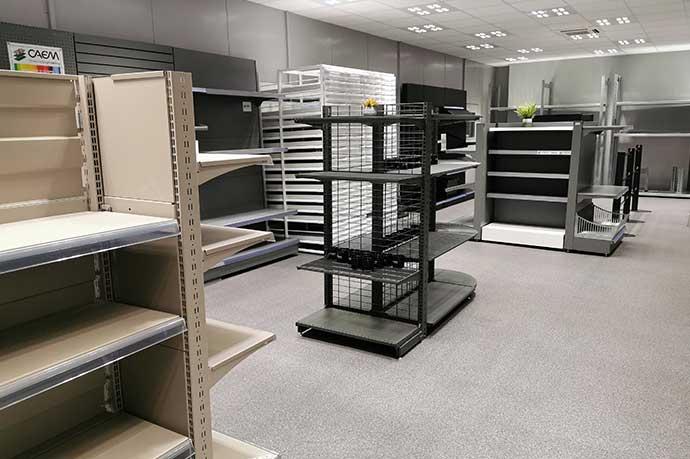
From everything I’ve seen in UK C‑stores, M25 is the undisputed winner when you’re serious about making small spaces work:
Central back panel
The design gives you a slim, central spine that makes better use of depth. You’re not fighting big, bulky uprights; you’re working with a lean structure that lets you merchandise on both sides efficiently.Low base
A lower base means more of the product is in the customer’s visible and reachable zone. You don’t waste vertical space at ankle height; you turn it into selling space.Slim shelves with hinging EPOS
These keep the bay feeling light and accessible, while still giving you the ticketing and price communication you need. The hinging EPOS makes adjustments and ticket changes quick, even in tight aisles.Wide range of sizes
The availability of many heights, widths and depths is what really unlocks the format. You can tune each run to the exact constraints of columns, doors, chillers and counters. That is how you optimise the use of every bit of space, rather than forcing a one-size-fits-all system into a non‑standard box.
In practice, this means more SKUs and better presentation in the same footprint, and aisles that feel more open than the drawing suggests.
Making counters and back-walls work harder
Another powerful lever in small stores is the counter and behind‑the‑counter area. This is prime, expensive space that is often frozen in a fixed design.
We’ve had strong results by rethinking this zone as a modular platform rather than a built‑once piece of joinery:
- Combining modular drawers and shelving behind the counter
- Designing the counter and back‑wall as one integrated system
- Keeping everything as adjustable as possible
This lets the retailer:
- Handle current categories efficiently (tobacco, vapes, high-value items, click & collect, services)
- Stay completely modular for future adaptations – new regulations, new services, category shifts
Instead of ripping out counters every time something changes, you reconfigure drawers, shelves and accessories within a structure that was designed to flex.
On a small footprint, that adaptability is as important as the initial density. The format you open with will not be the format you need three years later.
The critical decision: aisle widths at layout planning
All of this sits on one fundamental choice that has to be made early:
How wide does the client accept the aisles to be?
Get this wrong and no amount of clever shelving will save you:
- Go too narrow and you technically “fit” more fixtures, but the shop feels cramped, people avoid aisles, trolleys and baskets clash, and replenishment becomes a nightmare.
- Go too wide and you give away precious selling space that you may never get back.
So, at the layout planning phase, we always push for a clear decision:
- What is the minimum comfortable width for your customer profile (elderly, families, prams, baskets, trolleys)?
- How do staff move with cages, ladders and stock?
- Where are your genuine pinch points – doors, chillers, counters – that demand more room?
Once those decisions are made, we design the fixture scheme – M25 runs, counters, drawers, back-of-house racking – to work around that agreed aisle standard, not to erode it bay by bay.
That’s how you avoid the classic trap: a plan that looks fine in CAD but feels claustrophobic in reality.
Small store, big store thinking
The retailers who win in small formats are the ones who treat them with big‑store discipline:
- They start with clear rules on aisle widths, flows and sightlines.
- They choose systems like M25 that are designed for slim, configurable layouts.
- They invest in modular counters and back‑walls that can evolve without full rebuilds.
- They accept that layout planning is a strategic decision, not a last‑minute sketch.
From CAEM’s side, our job is to bring all of that together:
- The right system (M25 for C‑stores is a perfect example).
- The right mix of drawers, shelves and accessories behind the counter and in the aisles.
- The right layout decisions on width and flow, made early and respected all the way through.
Done properly, a small store stops feeling like a compromise. It feels like a focused, efficient, modern format that punches above its square metres – for customers, for staff, and for the P&L.