In theory, lead times are just numbers on a Gantt chart. In real life, they decide whether your stores open on time, your refits stay on track, and your internal sponsors keep backing your ideas.
From my seat as owner and MD, with 25 years across sales, design, manufacturing, finance and operations, I’ve seen one thing consistently: fixtures are often on the critical path – and most retailers underestimate how much their supplier model shapes that risk.
Where lead times really bite in retail
Lead times don’t usually hurt you on a generic, steady-state order. They hurt when something changes:
- A new format or concept is approved and the first stores need to open on a fixed date.
- A programme adopts new products or procured components (lighting, accessories, tech) that change the supply chain.
- A competitor moves faster, and your board suddenly accelerates a roll‑out.
- Another supplier fails to deliver, and you have to recover at short notice.
- A layout on site doesn’t match the drawings and you need extra or different kit to keep the opening date.
It’s in these moments that the difference between a trading/import model and a UK‑based manufacturer with serious capacity becomes obvious.
How CAEM manages new products and evolving programmes
On new projects, especially where we introduce new or procured components, our supply chain naturally adjusts:
- Early on, lead times can be slightly longer while we set up the right sourcing and validate components.
- As soon as we see that a client is committing to a format or product set, we tune up our stock and production planning to match their expansion curve.
This only works if we treat your growth as a joint plan, not a surprise:
- We ask clients to talk to us constantly.
- When you confidentially share your expansion and refit plans, we feed that into our internal systems:
- Stock planning for steel, powders and critical components
- Machine capacity planning
- Supplier orders and safety stocks
The result is that once a product has “settled” into the estate, we are usually ahead of the demand curve, not chasing it.
The backbone: UK manufacturing with spare capacity by design
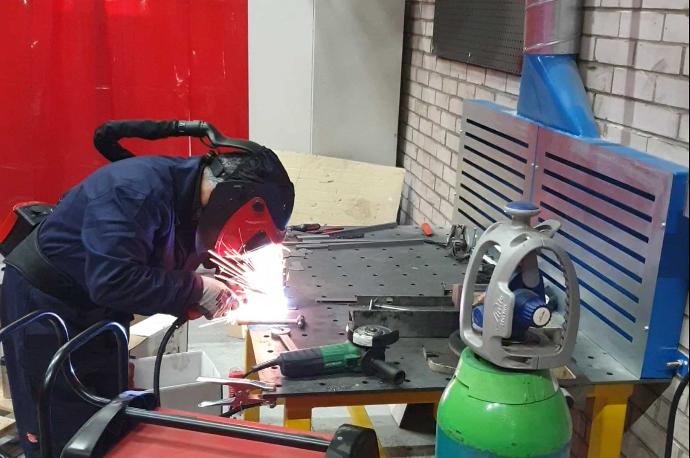
The biggest enabler behind our lead times is simple: we own and run our own manufacturing, in the UK, at scale.
That gives us three concrete advantages:
Core materials and components are always in stock
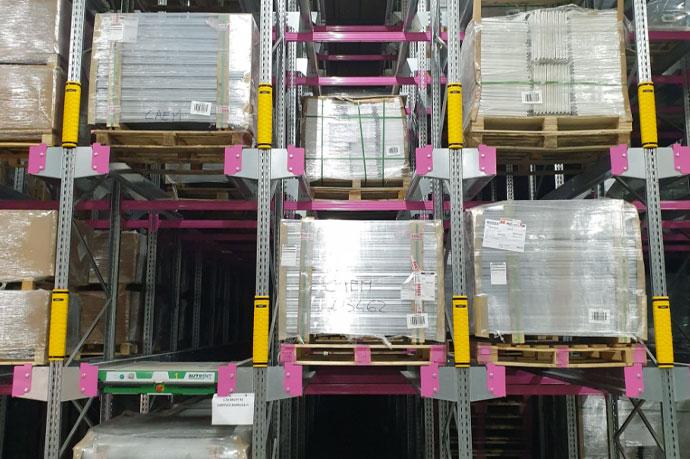
- Shelving steel, powders and other critical components are held at meaningful levels – not ordered last‑minute.
- We don’t wait for a full container from overseas before we can start your job.
Manufacturing is planned with spare capacity – on purpose
- Our planning model is built so that we always have headroom.
- This means when a critical job kicks in – an emergency, a rescued project, an accelerated trial – manufacturing can step in and absorb it.
Internal systems are tuned to each retailer over time
- As the relationship evolves, our systems learn your pattern:
- How often you refit
- How your formats grow
- Which kits and specials you standardise on
- Replenishments and manufacturing runs are adapted accordingly, driven by highly automated internal systems designed for our own operations and industry, not generic software.
- As the relationship evolves, our systems learn your pattern:
In practice: you are not fighting for space in a distant factory that barely knows your name. You are working with a UK operation that has structured itself to react.
Why communication is part of the lead-time solution
Fast, reliable supply isn’t just about what we do internally; it’s also about how we work together.
What helps us help you:
- Early visibility of pipeline plans – even if approximate.
- Transparent discussion about format ambitions, refit waves and likely volumes.
- A shared understanding that if you change direction quickly, we need to update stock and capacity plans in step.
When we get that, we can:
- Pre‑position raw materials and semi‑finished goods.
- Lock in capacity on the right machines.
- Build in contingency for the “unknowns” we both know will appear.
When we don’t get it, everyone ends up firefighting.
Real-world short lead times: when things go wrong elsewhere
You mentioned a “huge list” of short‑term projects. That’s not an exaggeration – we’ve seen many:
- Projects where another supplier failed to deliver and we were asked to step in.
- Situations where our contacts inside retailers needed to present something to their directors on very short notice, and we had to help them get fixtures or prototypes ready in time.
- Sites where last‑minute layout changes demanded extra kit or different components to avoid slipping an opening date.
In all of these cases, the same factors made the difference:
- Our own supply chain – stable, known, with continuous flows of steel and key inputs.
- Internal manufacturing – no need to find a new factory or negotiate a rush slot.
- Automated planning systems – we see quickly what can be reshuffled and what can’t.
Fast lead times are difficult to “warrant” in a legal sense – there will always be physical and logistical limits. But what we can guarantee is this:
Whatever is realistically possible to be done, will get done.
Because we’ve built CAEM so that reactivity is part of the normal operating model, not an emergency exception.
Why UK-based reliability matters to your programmes
For boards, property teams and format leads, this all rolls up into a simple question:
- Do you want your fixture programmes to depend on long, fragile supply chains and trading intermediaries?
- Or do you want them anchored in a UK manufacturing base with the flexibility to absorb shocks and seize opportunities?
Reliable, fast fixture supply:
- Keeps new formats and refits on schedule, preserving the business case you sold internally.
- Allows more confident trialling and iteration, because you know you can move quickly if a concept works.
- Gives you a realistic back‑up plan when other suppliers falter.
In my 25 years of doing this, the retailers who get the most value from fixtures are not the ones who saved 2–3% on a one‑off quote. They’re the ones who chose partners that could move at the speed of their business, and built open, honest communication around that.
That’s exactly what we’ve designed CAEM to do.