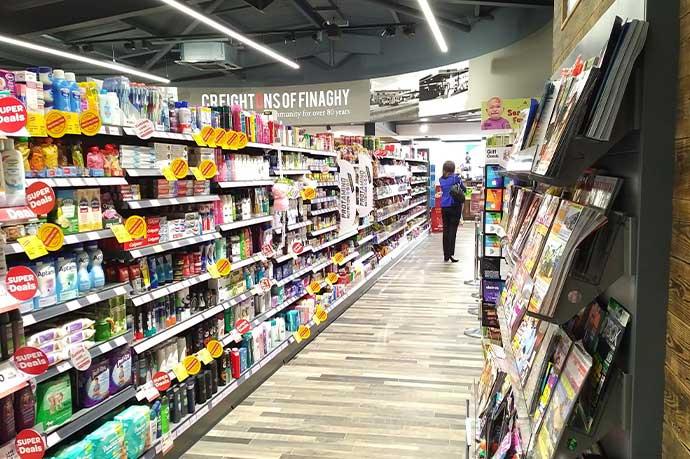
If you walk enough UK stores, you quickly see a pattern: the problem isn’t usually the shelving system itself. It’s what’s missing from it.
Small items sliding around, tall products falling over, messy promo ends, wasted top shelves, categories that never look quite “under control” – most of this comes down to not having the right accessories in the right place.
From my perspective as owner and MD, with a hand in design, manufacturing, commercials and finance, I see accessories as one of the cheapest and most powerful levers you have to make your space really sweat.
Where standard shelving fails without the right accessories
Standard bays will always have limits on their own. The real headaches appear in specific categories:
Small and mixed items
Cosmetics, OTC health, DIY fixings, electrical bits, impulse snacks. Without dividers and organisers, they slide, mix and hide, making shopping and stock control harder.Tall and unstable products
Bottles, sprays, rolls, long narrow packs. Without proper supports, they fall over, get pulled forward, and create a constant “tidy-up” loop for staff.Soft goods and loose ranges
Towels, cushions, pillows, throws. Piled on flat shelves, they slump, sprawl into aisles and lose all sense of value or order.Promo ends and impulse zones
Plain shelves at aisle ends turn into messy piles. Without tailored dump bins, wings or feature pieces, promotions don’t stand out and are hard to keep neat.Top shelves and high space
Often wasted or used as random overstock because there’s no thought given to how to present or secure items at height.
These problems are not solved by buying a different gondola. They’re solved by accessories that control product behaviour.
Why in‑house design and manufacturing matters here
Because we both design and manufacture in house, we’re not limited to a fixed, generic accessories catalogue:
- We can create specific displays for specific product ranges, based on what actually happens in your stores.
- We can refine details – wire pitch, divider spacing, lip heights, label positions – around real SKUs and real planograms.
- We can produce at scale and keep the cost sensible because we understand the manufacturing side as deeply as the design side.
That’s why, when you say “we want to fix this category, it never looks right”, my first thought isn’t “buy a different system”. It’s “what accessory will tame this product and make it work with the system you already have?”.
Concrete examples of accessories changing the game
You said “yes, all of them” – and that’s true: wire dividers, acrylic organisers, hooks, baskets, shelf organisers, etc. all have their place.
A few typical wins we see across retailers:
Wire and acrylic dividers for small items
- Turning a chaotic shelf of small packs into clear lanes.
- Each product has a defined home, which:
- Makes planogram compliance easier.
- Reduces mis‑fills and mis‑picks.
- Helps staff spot gaps quickly.
Shelf organisers for mixed SKUs
- In dark stores and back rooms, universal clear acrylic organisers allow you to mix goods on one shelf while keeping them clearly separated and easy to pick.
- That converts “random stock on a board” into a structured picking surface.
Wire frames and racks for soft goods
- For towels, cushions, pillows, blankets:
- Dedicated wire racks and dividers keep items upright and visible.
- The product, not the fixture, becomes the hero.
- Presentation stays consistent throughout the day, not just at the morning fill.
- For towels, cushions, pillows, blankets:
Hooks, baskets and wings for impulse and promo
- Simple hooks and baskets mounted on standard uprights create powerful impulse zones without building new furniture.
- Wings and side units let you hang or present SKUs exactly where they’ll be seen by the right traffic.
In all these cases, the shelf and upright don’t change. The accessory turns an average bay into a high‑performing one.
Accessories as “space multipliers”, not nice‑to‑have extras
The biggest mental shift I try to get across to cost‑driven clients is this:
Accessories are not decorative extras. They are space multipliers.
A few small pieces of well‑designed metal or acrylic can:
Unlock more SKUs on the same metre
- By controlling product position and orientation.
- By letting you use depth and height without chaos.
Improve clarity and planogram compliance
- Staff can see where each line belongs.
- It’s harder for ranges to drift over time.
Make life easier for staff
- Faster to replenish – products go into clear lanes or pockets.
- Easier to keep tidy, reducing “housekeeping” time.
- Simpler to train new staff: “this product always lives in this kind of divider/basket”.
From a finance point of view, the ROI is usually exceptional:
- Low capex per bay.
- Daily impact on how effectively that bay sells and how much labour it consumes.
- Minimal risk: if a concept changes, most accessories can be redeployed to other categories.
Don’t let capex fear block sales and efficiency
You summed it up clearly:
The fear is for the client to focus on capex and not on making the shop space SWEAT.
I see that all the time:
- People worry about every pound spent on accessories.
- They forget that the shelves they’re “saving” on might carry hundreds of thousands of pounds of product over their life.
- They accept messy, inefficient categories because “that’s just how it is”.
The reality is:
- Capex is finite, so it should be directed where it moves the dial most.
- Accessories that are specifically designed for specific products and ranges are exactly that: small, targeted investments that make space more productive.
When you work with a manufacturer like CAEM, who both designs and builds these solutions, you’re not buying trinkets. You’re buying engineering for your P&L:
- More sales per metre.
- Less wasted staff time.
- Better customer perception of the same products.
How to approach accessories with CAEM
The most effective way to use accessories is straightforward:
Identify the problem categories
- Which ranges always look messy?
- Where do staff complain about tidying or refilling?
- Where do you feel you’re under‑using the vertical or depth?
Share real photos and constraints
- Products, packs, shelves, current displays.
- Any rules on heights, safety, accessibility.
Let us propose and prototype
- We can design or select accessories that work with your existing CAEM systems.
- We can mock up bays in our factory to show you the difference.
Roll out with clear guidance
- Simple rules for staff: how to dress, refill and maintain the new setup.
- Then measure: tidiness, speed, sales where you can.
If you already have good gondolas in place, accessories are often the fastest way to make your shop space truly sweat. And with in‑house design and manufacturing behind them, they’re not just bits of metal and acrylic – they’re tailored tools for your specific products to be shown at their best and lift their sales.