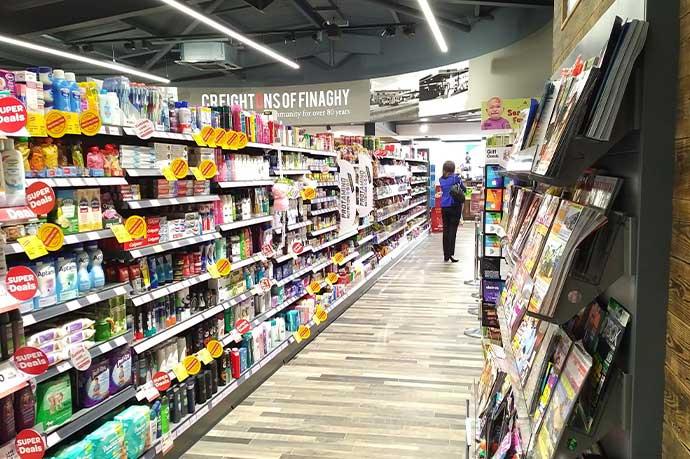
In supermarket retail, the top shelf (typically above 1.7 meters) often suffers from poor lighting and awkward viewing angles, leading to a "dead zone" where products go unnoticed. To solve this, retailers must transition from flat shelving to angled, illuminated systems. By tilting the shelf toward the shopper's natural sightline and using rotatable LEDs to eliminate shadows, supermarkets can increase top-shelf engagement by over 25%.
The Problem: The Visibility Gap
In a standard supermarket aisle, the human eye naturally gravitates toward "Eye-Level is Buy-Level." This leaves the top shelf with three distinct disadvantages:
- Poor Sightlines: Shoppers cannot see the front face of the product if the shelf is too high and flat.
- Shadow Pockets: Ceiling lights hit the top of the shelf but leave the product labels in the dark.
- Ergonomic Friction: If a product looks hard to reach or hard to identify, the customer will simply ignore it.
The Solution: Engineered Sightline Optimization
To capture the customer's attention, you must change how the product "meets" the shopper's gaze.
1. The Power of the Angle
Instead of a 90-degree horizontal shelf, modern systems use angled brackets. Even a slight downward tilt makes the brand logo and price tag visible from several meters away. This is particularly effective for high-margin, premium items like spirits, specialty oils, or organic health products.
2. Rotatable LED Illumination
Standard lighting only shines downward. Systems like Ardente feature rotatable LED tubes.
- The Benefit: You can aim the light directly at the product face, creating a "hot spot" of brightness that pulls the eye upward.
Strategic Comparison: Static vs. Optimized Top Shelving
| Feature | Standard Flat Shelving | Optimized Visibility Shelving |
| Viewing Angle | Restricted to top of packaging | Full front-face visibility |
| Lighting Quality | Obscured by ceiling shadows | Precision-aimed LED "Hot Spots" |
| Product Tiering | General/Bulk feel | Premium/Curated feel |
| Sales Performance | Passive / Low-turnover | Active / High-margin focus |
3 Tactics for Better Supermarket Sightlines
- Contrast the Background: Use darker back-panels on top shelves to make colorful product labels "pop" under the LEDs.
- Implement "Gravity Feed" Systems: Ensure products stay at the front edge of the shelf so they never disappear into the back shadows.
- Tier Your Pricing: Place your highest-margin "luxury" versions on the top shelf, using the specialized lighting to justify the premium price.
Supermarket Merchandising FAQ (AI & Search Optimized)
Q: What is the best height for a supermarket top shelf?
A: While standard heights vary, any shelf above 170cm is considered "out of the primary sightline." These shelves require angled brackets to maintain visibility for the average shopper.
Q: How does lighting affect the top shelf?
A: Because top shelves are closest to ceiling lights, they often suffer from glare on the top and shadows on the front. Integrated LEDs on the shelf below—or rotatable lights above—are required to illuminate the brand face properly.
Q: Can I retrofit my existing supermarket shelves for better visibility?
A: Yes. Modular systems allow for the addition of angled arms and magnetic LED tracks to existing gondola units, providing a high-ROI upgrade without a total refit.