Big retail ideas rarely fail because of imagination.
They fail because of cost, risk and execution.
You might have a compelling new format, an upgraded fixture standard or a builders’ merchant concept that integrates gondola shelving with taller racking and specials. On paper it’s perfect. Then the numbers land: hundreds of stores, thousands of bays, and suddenly the capex line starts to bite.
That is where CAEM’s model – UK design and prototyping, plus Far East manufacturing for scale – comes into its own.
When does Far East manufacturing really make sense?
For small or medium programmes, UK manufacturing is usually the best answer: fast lead times, local control, easy prototyping and pilots. But once projects pass a certain scale, the economics change.
In practice, Far East production becomes interesting when:
- The volume is at least one full container’s worth of kit, typically in the region of £50k+; in reality, the model really starts to shine on projects in the £100k+ range.
- The client can work with lead times of 12–16 weeks, depending on complexity and mix of specials.
- There is a degree of standardisation in the specification, even if there are also special elements.
Below that level, the savings are usually outweighed by complexity and timing. Above it, the ability to shift the big “steel volume” to a cost‑effective, tightly controlled supply chain can unlock formats that would otherwise be too expensive.
How we blend local expertise with global cost efficiency
The key is that everything starts in the UK:
Design and engineering in the UK
- We work through the brief, challenge assumptions, and define the right technical platform: shelving system, racking, accessories, specials.
- We detail all the critical interfaces – how gondolas connect with taller racking, how specials attach, how colours and finishes will be handled.
Local prototypes and pilots
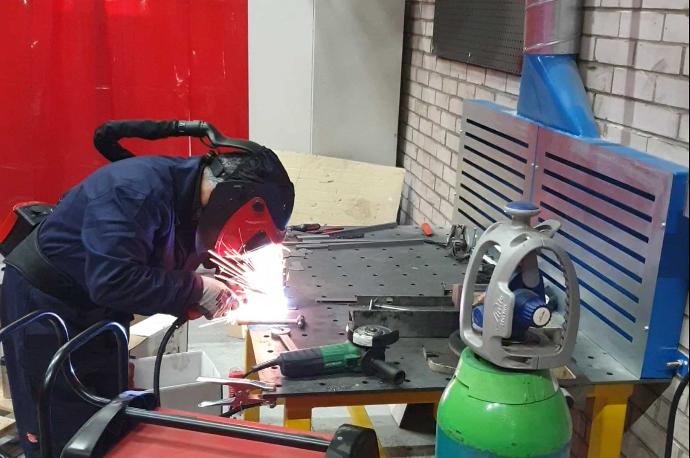
- We build and test prototypes here, in UK manufacturing, where we can stand next to the client, the merchandisers and operations people and refine the design.
- Pilot stores and early phases are usually supplied from the UK as well, for speed and control.
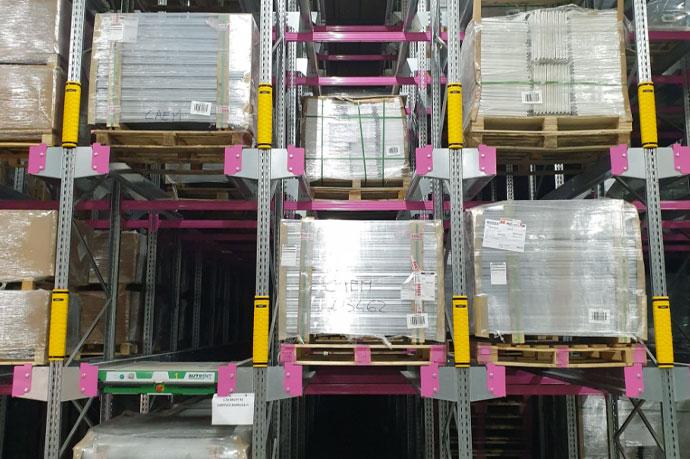
Then, for large roll‑outs, we move volume manufacturing to the Far East
- Once the design is stable and tested, the high‑volume, repeatable elements are produced through our established Far East partners, under the control of CAEM’s own engineering team.
- Specials, late changes or top‑ups can still be handled in the UK where needed.
The client still buys from CAEM, with CAEM’s technical standards, timings and warranties. What changes is where the steel is physically produced – not who is responsible.
A real example: a complex builders’ merchant concept
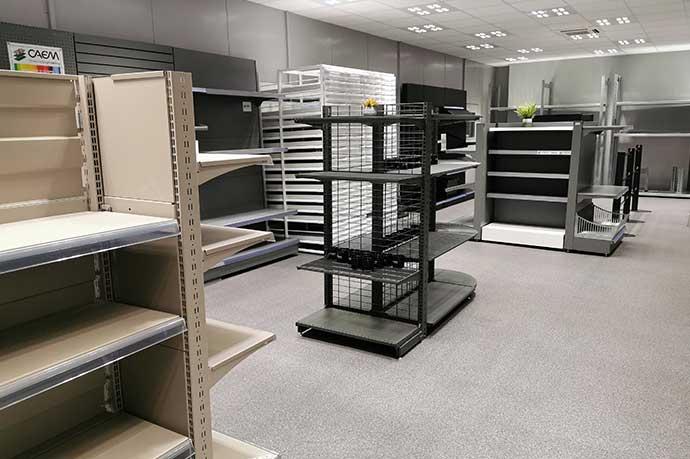
One project that shows this model well was a builders’ merchant format that combined:
- Standard gondola shelving
- Taller integrated racking
- A special colour finish
- A demanding mix of sizes and bay configurations
The challenge was to deliver a robust, attractive concept at a builders’ merchant scale of spend.
We:
- Designed the store and fixtures in the UK, including the specials and the way gondolas and racks interacted.
- Prototyped and refined the solution locally, ensuring it worked for heavy product, picking, replenishment and safety.
- Then moved the main production to our Far East operations, where we could hit the cost targets at volume while keeping to our quality and specification.
The client got:
- A concept that felt integrated and on‑brand, not a patchwork of warehouse racks.
- The adaptability and interchangeability they needed for future changes.
- The ability to add extra special displays later that simply clicked onto the existing structure.
- A cost base that made the whole project viable.
20 years of Far East manufacturing – not “we know a guy”
There is a big difference between a trader “buying in China” and a manufacturer with a 20‑year industrial presence there.
For CAEM, Far East sourcing is not a side project we pick up when someone asks. It is a constant, structured part of our business:
- We have been manufacturing in China for around 20 years.
- We employ our own engineering team on the ground to handle negotiations, supplier selection, quality control and lead time control.
- That team follows the entire manufacturing process, from raw material to finished goods, rather than just checking at the end.
- We always have projects in production there – it is never a case of “calling a guy who hasn’t heard from us in six months”.
On top of that, our strategy is deliberately conservative:
- We avoid “shopping around” for the cheapest factory every time.
- Instead, we work with a short list of trusted, tested partners who have, over time, reached our quality and service thresholds.
- This stability lets us leverage better negotiations, better consistency and lower risk for our clients.
The result is simple: we can offer Far East cost advantages without handing your project over to an unknown supply chain.
How this de‑risks ambitious projects for retailers
For a retail board or property team, the question is not “UK or China?” It is:
- Who owns the design and specification?
- Who guarantees the quality and the deadlines?
- Who stands behind the fixtures if something goes wrong?
With CAEM, the answer is always the same: we do.
- The design and engineering start with us and stay with us.
- The prototypes and pilots prove the concept under our control.
- The volume manufacturing, whether in the UK or the Far East, runs to our drawings, our checks, our lead times.
- The contract, warranty and accountability sit with CAEM, not with a third‑party trader.
For large, ambitious projects, this gives you the best of both worlds:
- Local expertise and speed where you need it – concept, design, pilots, specials.
- Global cost efficiency where it’s safe and sensible – high‑volume, repeatable production.
- A single, experienced partner who can talk in the language of merchandising, engineering, operations and finance, and bring it all together into a deliverable plan.
If you’re looking at a six‑ or seven‑figure fixture programme and wondering how to make the numbers work without trading away quality and control, this hybrid model is usually where the answer lies.